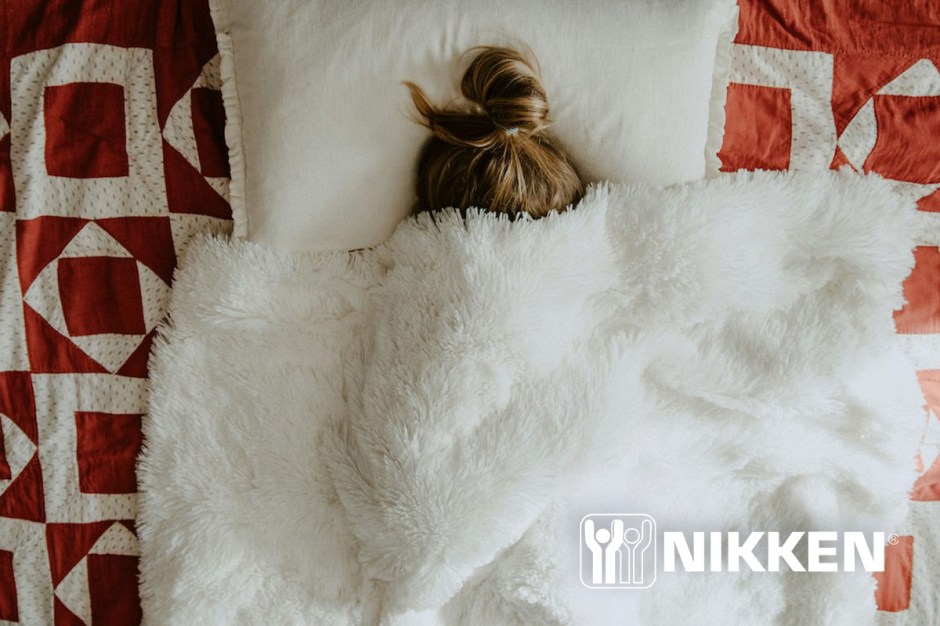
You Can Create a Sleep Sanctuary

Sleeping well is a challenge for many people. Often, it’s because keeping up with the demands of family, friends and work can cause a huge amount of stress. The result is that neither body nor mind can decompress enough to get a good night’s sleep.

Fortunately, there are actual steps you can take to create a “sleep sanctuary,” some place pleasant and cozy, relaxing and soothing:

1. Perhaps the most important item in a sleep sanctuary is the bed. Regardless of the type of frame you choose for your bed, the mattress is important and should suit your personal needs. Do you like firm, medium or soft? More importantly, what type of mattress suits your spine? For example, even if you prefer a soft, cushy mattress, if your spine is weak, you would probably be better off with a firm mattress, because it affords more support.

Solution: No matter what type of mattress you currently have, the Kenko Naturest® Fit is a topper that sits right under your fitted sheet, in twin, full, queen or king sizes. The Fit is made with sculptured rubberthane latex, which provides massaging effects while allowing for air circulation and ceramic reflective fibers that help regulate body temperatures. 800 gauss magnets create a magnetic field which cocoons the body for relaxation to help improve sleep. Tourmaline gives off electrons that help create calming effects when exposed to pressure, heat or motion, which is provided by your own body as it lays on top of the Fit.

2. Just as the Kenko Naturest® Fit supports your comfort, what your skin actually touches also can make a difference in how well you sleep. Choose linen that feels the most comfortable for you. Invest in natural fabrics, such as cotton, flannel, flax or even silk. Manmade fabrics do not allow air to circulate as freely and may even cause itchy or sweaty skin. Natural fabrics help regular temperatures—cools in hot months and warms in cold ones.

3. Do the breath test of your bedroom or wherever you want your sleep sanctuary to be. Inhale in and out slowly. What do you smell? Since you will be spending all night in the sleep sanctuary, you need to make sure the air is fresh. Stale or unpleasant odors are not conducive to restful sleep. If there is a window, make sure to keep it open at least for a few hours every day so the room has outside air flowing through. Indoor air often contains more contaminants than outdoor air! Dust, pet dander, pollen and odors are typically in household air. Mold, mildew and dust mites may be present. Even gases such as radon and carbon monoxide are found in measurable quantities in many homes.

Solution: Whether you have a window or not, the KenkoAir Purifier®provides multiple-stage HEPA filtration, is energy efficient and includes a deodorizing filter. It operates quietly, is ozone-free and has a negative-ion generator.

4. Many people enjoy the aroma of essential oils. Lavender and cedarwood are examples of essential oils that people choose to de-stress and relax for better sleep.

5. Is your sleep sanctuary dark? Sleep scientists agree that a cool, dark environment is ideal for sleep. You can use black out curtains or wear a sleep mask.

Solution: The Kenko Power Sleep Mask not only helps block out light like a typical eye mask. It also helps relax the entire eye area, using similar technologies to those found in the Kenko Naturest® Fit. The Power Sleep Mask is made with patented Dynaflux® magnetic technology, ceramic reflective fibers and tourmaline technology which helps produce a calming effect. When your eyes are relaxed, you have a much better chance at sleeping through the night.

6. A sleep sanctuary is for rest. Your best bet is to create an environment that is natural—you might want a few green plants, but try to limit the clutter. For example, you don’t need to keep piles of books or clothes in a sleep sanctuary. Instead, hang simple photos or art on the walls and limit the amount of unnecessary furniture or accessories. In other words, create a space that you look forward to retiring in every night!

From now through October 31st, take advantage of free ground shipping on any size Makura Sleep Pack and other select Kenko Sleep products!

Inhale Positive Energy, Exhale Stress

Did you know that our respiratory system works hard for us by taking in 20,000 breaths daily? Deep breaths are more efficient: they allow us to fully exchange incoming oxygen with outgoing carbon dioxide. They have also been shown to slow the heartbeat, lower or stabilize blood pressure and lower stress.1 That’s why it’s so important to make sure the air we breathe in is clean and energizing.

According to a two-year study led by researchers at Intermountain Healthcare in Salt Lake City, Utah, outdoor air pollution is a major contributor to indoor air pollution, but HEPA filters in the home may significantly reduce fine-particulate matter in the air compared with non-HEPA air filters. They found over a 12-week period of time that HEPA filters reduced indoor particulates by 55% and outdoor pollutants coming inside by 23%.2

HEPA stands for “high efficiency particulate air” and the HEPA standard is defined by the United States Department of Energy. First developed in the 1940s, HEPA filters were used to trap potentially radioactive particles found in facilities containing nuclear materials. By the 1960s, HEPA filters expanded into the consumer market for air conditioners, vacuum cleaners and stand-alone air purifiers.3

The Environmental Protection Agency (EPA) has recommended air purifiers as an effective tool to combat viruses and smoke, noting that the airborne particles from smoke and respiratory aerosols that contain viruses are often in a similar size range, mostly between 0.1 and one micron. Authentic HEPA filters are able to trap particles of this size range effectively.4

HEPA filters are not all the same. Because these filters are designed to run 24/7, they can run up your energy costs. Therefore, an Energy Star qualification is recommended.5

Air filter construction is another consideration. If air can flow around the filter, it is less efficient. Some filters are labeled “HEPA-style” and these generally are not air-tight.

Nikken supports clean air every day with eco-friendly KenkoAir Purifier® and its HEPA replacement filters. To celebrate the global effort for “healthy air, healthy planet” Nikken is offering two specials for the entire month of September. You save significantly when you purchase the September Exclusive Pack (Item 4445) by receiving the KenkoAir Purifier® and HEPA replacement filter for the price of the KenkoAir Purifier. In addition, all KAP HEPA filter replacements (Item 1445) are 20% off.

Here are some specific benefits of the KenkoAir Purifier that go above and beyond a standard HEPA filter and that Nikken is proud to share:

• The KenkoAir Purifier® (KAP) houses an advanced, multiple-stage HEPA filtration system that actually exceeds the measured efficiency of capturing up to 99.97% of 0.3 micron particles in the air. (0.3 microns is approximately 3% of the diameter of a human hair6)

• The KAP operates ozone-free so it is non-toxic and environmentally-friendly.

• The advanced system is designed to generate negative-ions, similar to those found in natural environments, such as forests and lakes.

• Energy Star qualified, the KAP is 35% more efficient than standard models and saves at least 215 kilowatt-hours annually. Its power consumption is designated at 55 watts and covers 313 sq. ft./29 sq. m.

• Having a re-usable prefilter reduces the KAP’s carbon footprint.

• Replaceable filters extend the longevity of the KAP.

• In addition to environmentally-friendly active carbon and microfibers, even the body of the KAP is made of recyclable materials, such as polyurethane, polypropylene and ABS plastic.

• The KAP allows you to select manual or automatic operation, and you can clearly see the condition of the room air from the air quality display on the top of the unit.

To breathe is to live and the KenkoAir Purifier helps us on our path to Active Wellness.

1 https://www.uchealth.org/today/understanding-breathing-and-the-importance-of-taking-a-deep-breath/

2, 3, 6 https://www.sciencedaily.com/releases/2018/09/180925110030.htm

4 https://www.epa.gov/indoor-air-quality-iaq/what-hepa-filter-1

5 https://www.washingtonpost.com/health/why-hepa-air-purifiers-are-the-best-in-fighting-indoor-pollutants/2021/08/20/70aa6888-ec06-11eb-8950-d73b3e93ff7f_story.html