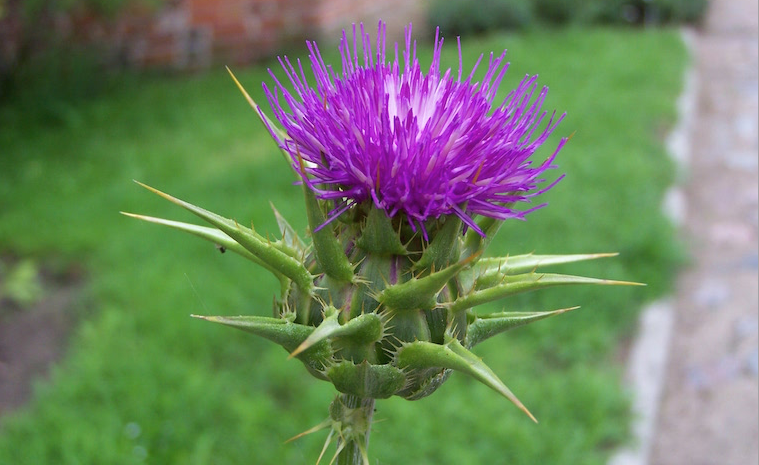
Nature’s Own Liver Supporter

The U.S. National Library of Medicine and the National Institutes of Health (NIH) have catalogued more than 400 scientific studies of Milk Thistle and its active compounds in their database. Milk Thistle is widely thought to be one of the most beneficial herbal remedies used globally.

Used for more than 2,000 years to support the liver naturally, Milk Thistle gets its name from the white fluid that comes from the plant’s leaves when they’re crushed. Over the past 40 years, intensive chemical, pharmacological and clinical research has confirmed the therapeutic value of Milk Thistle in a wide range of liver-related as well as non-liver-related conditions.

  • The active component in Milk Thistle is known as Silymarin, a flavonoid that is both an anti-inflammatory and an antioxidant, which may help decrease oxidative stress.* According to Web MD, Silymarin is sometimes used as a natural restorative for liver and gall bladder issues.
  • Milk Thistle is known to help protect the liver from toxins, including the effects of alcohol. In the EU, Milk Thistle is sometimes prescribed as medication.
  • The American Botanical Council published a study on August 16, 2004 showing that Milk Thistle exhibited promise for “stimulating cell regeneration in the kidneys.” Milk Thistle’s effect on kidney health is believed to “closely mirror the herb’s effects on the liver.”
  • The same study showed that Milk Thistle “appears to raise levels of beneficial HDL cholesterol and may also help reduce blood pressure.”
  • The renowned Mayo Clinic has published insights on Milk Thistle, including findings that show the herb “may improve blood sugar control.”
  • Milk Thistle even “appears to have neuroprotective properties.”1

Take a look at the label of Kenzen® Cleanse & Detox. The botanical you see is the Milk Thistle plant. It is an important ingredient of the Proprietary Synergistic Cleanse & Detox Complex.

*This statement has not been evaluated by the Food and Drug Administration. This product is not intended to diagnose, treat, cure or prevent any disease.

1          Biosci Biotechnol Biochem. 2010;74(11):2299-306.


How does Chicory Root help Cleanse & Detox?

Our bodies simply do not function at 100 percent when it comes to absorbing good nutrients and expelling toxic or nontoxic waste. Retention of toxins can make us sick in various ways. Fatigue, headaches, indigestion, constipation, insomnia and “mystery” discomforts can all be attributed to toxins doing their evil work in our bodies. Even mental conditions such as depression, anxiety and an inability to focus may result from toxins trapped in the body. They can reside in the liver, kidneys, colon, lungs, skin and the entire lymphatic system.cleanse ans detox picture

Image courtesy of lifehack.org

No wonder many people go overboard with colon cleanses to detoxify and end up with even more problems. According to the Mayo Clinic, “Colon cleansing can sometimes be harmful. In fact, coffee enemas sometimes used in colon cleansing have been linked to several deaths. Colon cleansing can also cause less serious side effects, such as cramping, bloating, nausea and vomiting. Other concerns with colon cleansing are that it can increase your risk of dehydration, lead to bowel perforations, increase the risk of infection and cause changes in your electrolytes, which can be dangerous if you have kidney, heart disease or other health problems.”

A gentler and far more comfortable way to help the body cleanse and detoxify is to take an organic nutritional supplement, especially one that targets the liver, the organ that is key to the elimination of bodily wastes. Kenzen® Cleanse & Detox is a NikkenWellness proprietary blend with roasted organic Chicory Root as one key ingredient. Roasted organic Chicory Root helps support the breakdown of fats by increasing the flow of bile through the liver.* Chicory Root is high in antioxidant compounds, contains a soluble fiber that helps feed digestive flora in the intestines and is a mild laxative.*

Herbalists use Chicory Root as a natural protector of the liver. The ability of Chicory Root extract to protect against chemical-induced free radicals and possible toxicity to the liver was reviewed in a 2015 medical review. Subjects were divided into four groups, according to treatment type, levels of damage and antioxidants reviewed during the process. Pretreatment with Chicory Root extract significantly reduced oxidative stress and prevented cell damage, ultimately improving liver conditions due to toxicity.1

Chicory Root is also a natural prebiotic, which promotes gut health. Inulin is the substance found in Chicory Root that is considered a prebiotic fiber, because it is easily fermented and helps to promote the growth of probiotics in the digestive system. Pre- and probiotics work best in tandem.

The inulin in Chicory Root also helps to relieve constipation. The impact of daily consumption of 15 grams of chicory on elderly constipated volunteers was examined in a double-blind, placebo-controlled study over 28 days. Volunteers in the inulin group reported increased satisfaction with digestion and decreased constipation.2

We’ll be taking a look at other key ingredients in the Kenzen® Cleanse & Detox formulation in the next few weeks.

*These statements have not been evaluated by the Food and Drug Administration. This product is not intended to diagnose, treat, cure or prevent any disease.

  1. PLoS One. 2015 Mar 25;10(3):e0121549. doi: 10.1371/journal.pone.0121549. eCollection 2015.
  2. Int J Food Sci Nutr. 2011 Mar;62(2):164-70. doi: 10.3109/09637486.2010.527323. Epub 2010 Nov 23.

Mushrooms that Feed the Brain

In Asia, the Lion’s Mane Mushroom is said to give you “nerves of steel and the memory of a lion.” It’s been used by Chinese herbalists for centuries as a general restorative but also has been recognized as positively affecting brain function.

Besides being called Lion’s Mane Mushroom, Hericium erinaceus is known by various other names: bearded tooth fungus, bearded hedgehog, bearded tooth mushroom, “smart mushroom” and in Japan, yamabushitake. The “smart” aspect of the Lion’s Mane Mushroom is the focal point of western researchers, and evidence now exists that this species encompasses characteristics that help improve cognitive function, including memory, attention and creativity.1

In one of the few human studies to date, older adults with mild cognitive impairment were given 250 mg powdered Lion’s Mane Mushroom thrice daily for 16 weeks. Compared with another group that received a placebo, the group taking Lion’s Mane Mushroom scored significantly higher on the cognitive function scale, with no adverse effects. 2

Two unique compounds found in Lion’s Mane Mushroom enable it to nourish the brain. These compounds, hericenones and erinacines, are known as powerful Nerve Growth Factor (NGF) inducers. NGF is a protein that is important in the maintenance, survival and regeneration of neurons in the central and peripheral nervous systems—the compounds are able to cross the blood-brain barrier to stimulate production of neurons.3

Ongoing research continues to confirm the potency and potential of Lion’s Mane Mushroom as a brain and cognition enhancer, and therefore a valuable nutritional supplement, especially as life spans continue to lengthen. Organic Lion’s Mane Mushroom is the first ingredient in the Organic Fermented Brain Support Blend in Kenzen® Clarity, formulated so that your mind stays as nimble as your body in the pursuit of Active Wellness and healthy longevity.

  1. https://www.braintropic.com/nootropics/lions-mane-mushroom/
  2. Koichiro Mori, Satoshi Inatomi, Kenzi Ouchi, Yoshihito Azumi, Takashi Tuchida, Improving effects of the mushroom Yamabushitake (hericium ernaceus) on mild cognitive impairment: a double-blind placebo-controlled clinical trial. Phytother Res.2009 Mar;23(3): 367-72.
  3. Koichiro Mori, Yutaro Obara, Misturu Hirota, Yoshihito Azumi, Satomi Kinugasa, Satoshi Inatomi, Norimichi Nakahata, Nerve growth factor-inducing activity of Hericium erinaceus in 1321N1 human astrocytoma cells, Colorectal Dis. 2007 Jul;9(6):549-52.